Showing posts with label Hellas. Show all posts

January 29, 2013

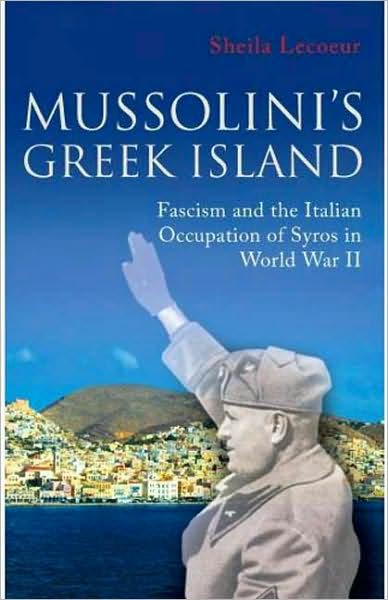
Mussolini's Greek Island


Chapter 8 THE SOCIAL IMPACT OF OCCUPATION

The low status of poorer, especially unmarried women, made them vulnerable to sexual exploitation. The sudden rise in casual sex in return for food, threatened social conventions and the island’s clergy remonstrated about what they saw as the ‘vertiginous decline in morality’. Of the many girls and women who resorted to relations with Italian soldiers in order to survive, most were aware that there would be a high price to pay for transgressing taboos. But faced with starvation, unmarried women’s options were restricted; in a dowry-based marriage system, girls from destitute families had little prospect of any wealth in the future and stood much less chance of getting married after the war. The social importance vested in the dowry was such that some women refused to sell their embroidered linen dowries even when they were starving because, as they said, it had taken them years to make and they would not be able to do so again. Women’s poor prospects and social worth were undermined even further by the general indigence of the population and indeed it is likely that in some cases their own relatives sent them out to procure food from the Italian soldiers, in return for sex. (In fact, the practice existed elsewhere: in Italy, police reports gave evidence of families suffering from near-starvation who exploited their daughters in this way).

Although it was rumoured that Catholic women were more disposed to trading sex for food, which was ‘widespread’ in the town, Orthodox women were equally vulnerable. In fact, most soldiers had little contact with the majority of the Catholic population as they were garrisoned in Ermoupolis.Rigoutsos expressed shock that women from ‘good families’ resorted to ‘prostitution’, suggesting that on every level of society, no one was immune from the degrading consequences of famine. It was well know that, in the murky moral climate of a society in crisis, there were those who were ready to exploit this particular ‘market’, resulting from the Italian army’s demands for sex. These dealers were rated as the most amoral among Syros’s newly rich profiteers. According to Mihalis Stefanos, women were used to extract export permits from the Italians in exchange for a few scraps of food; the women then handed over the permits to the ‘irreproachable Greek operating behind the scenes’. Stefanos thought that the aim was to accustom the girl who returned ‘to be subjected to humiliation time and again, just to get something to eat for a short while’. He reviled his ‘fellow-citizens’ for their betrayal of their own society and nation. For him these men were traitors whose behaviour threatened the moral fabric of the island community. The perception that there was a link between the trade in permits and prostitution was common and came up in the first newspapers published after the occupation by the communist-led resistance group EAM. On the whole, the blame was cast on the women, and scabrous songs and jokes expressed the community’s disapproval of women who associated with the occupiers. Nevertheless there was an awareness that these transactions had ‘protected the lives of the women themselves and entire families’.

The harshness of sexual trading was mitigated in cases where men and women negotiated a stable agreement providing for their mutual needs, or were drawn together by genuine affection. One Orthodox interviewee, living in a village outside Ermoupolis during the occupation, was very reluctant to admit that she was a ‘housekeeper’ for an Italian soldier although this enabled her to survive after her brother and sister had died of starvation. But the scars of the past have still not been effaced and even today both she and her daughter are still reticent about the social stigma attached to her behaviour.

March 10, 2012

Ezra Pound: Peaceful Methods From The Byzantine Empire

Ezra Pound On Preventing Zionist Conquest From Within
Peaceful Methods From The Byzantine Empire
From Dick Eastman / 12-30-2009

Before you call the following proposals "undemocratic" let me ask you this:

Is it being "anti-democratic" to oppose billionaire Jews having "the same democratic right" to use their money and position to influence politics as the man I just saw standing on a corner with his daughter in sub-freezing temperatures holding up a large piece of cardboard with this legend: saying :

"I am not a bum.
Unemployed brick layer.
Three kids. Will do any work.
Please help."
Has the "equal freedom" to use his money and position to do the same? The Greeks knew that all such "democracy" is always in reality oligarcy (or, inpopulist lingo, plutocracy.) The Byzantine civilization derived from the Greek, and the Moslems adopted some of their wisdom in building their civilization.
I say Intelligent government for the good of all in a republic cancels such bogus and unegalitarian "equal rights" of the rich and poor to influence politics -- in order to realize the ideals of a democracy. Anti-trust against the rich and not the poor is unfair and undemocratic to some, but to me it is the only way to get justice and an economy we can live with.
After you read the following view the short Mullins clip -- linked below to view on line. --Dick Eastman

Excepted from NEW HISTORY of the JEWS
By Eustace Mullins
In all of recorded history, there was only one civilization which the Jews could not destroy. Because of this, they have given it the silent treatment. Few American college graduates with a Ph.D. degree could tell you what the Byzantine Empire was.

It was the Empire of East Rome, set up by Roman leaders after the Jews had destroyed Rome. This empire functioned in Constantinople for twelve hundred years, the longest duration of any empire in the history of the world.

Throughout the history of Byzantium, as it was known, by imperial edict, no Jew was allowed to hold any post in the Empire, nor was he allowed to educate the young. The Byzantine Empire finally fell to the Turks after twelve centuries of prosperity, and the Jews have attempted to wipe out all traces of its history.

Yet its edicts against the Jews were not cruel; in fact, the Jews lived unmolested and prosperously in the empire throughout its history, but here alone the vicious cycle of host and parasite did not take place.

It was a Christian civilization, and the Jews were not able to exercise any influence. Nor did the Orthodox priests bewilder their congregations with any vicious lies about Christ being a Jew.

No wonder the Jews want to eradicate the memory of such a culture.

It was Ezra Pound who launched upon a study of Byzantine civilization, and who reminded the world of this happily non-Jewish land.

From the Byzantines, Pound derived his no-violent formula for controlling the Jews.

"The answer to the Jewish problem is simple," he said.

"Keep them out of banking, out of education, out of government."

And this is how simple it is.

September 08, 2011

Formation of the Hellenic Christian Mind

Demetrios Constantelos

The Formation of the Hellenic Christian Mind

From his book: Christian Hellenism. Essays and Studies in Continuity and Change Publishing by Aristide D. Caratzas, New Rochelle, New York & Athens ISBN: 0-89241-588-6

TELL this tο the king; the decorated court has fallen tο the ground, Phoebus nο longer has a cell, nor laurel of prophecy, nοt babbling fountain; even the chattering water has dried up.
Anonymous, Fourth Century A.D.

The medicæval Greek or "Byzantine" mind was the product of the fusion of several intellectual, cultural, and religious traditions of antiquity, such as the Greek, Roman, Hebrew, Iranian, and Christian. But it was the humanistic mind of ancient Hellas and the Christian faith that contributed the most to the genesis, formation, and evolution of the Byzantine mind. The thought of the ancient Greeks was very much alive during the Byzantine era because the Greek classics -literatιιre, philosophy, history, art, education and even mythology- constituted the curriculum of education throughout the Byzantine millennium.

Because the Byzantine era was profoundly religious, the future of the ancient Greek cultural heritage -especially literature and philosophy- in the Byzantine Empire was determined primarily by the attitude of the Church toward secular learning.


I


Tο appreciate the place of the classics in the Byzantine state, one needs to understand the nature of the conflict between Greek thought and Christian faith as it evolved in the early Christian centuries. The encounter between Christianity and classical padeia (education) produced the forces which determined the future of the Byzantine Greek mind.


As early as the Apostolic age, attempts were made to present the new faith in a way that nοn Jews would understand. St. John wrote the fourth Gospel for people of Greek background. John's opening words "Ιn the beginning was the Logos," as well as his meditative, mystical, symbolic and philosophical terminology are borrowings from Heraclitus, the Stoics, and Hellenic thought in general. His well chosen words logos, light, darkness, flesh, birth, son, life, eternal life, bread of life, water of life, sign, spirit, resurrection, and many more were intended to stress not only the pre-existence of Logos the Christ, but also God's involvement in history outside of ancient Israel. The implication was that the God of Israel was the God of the Greeks, Romans, Scythians, and others, that there was nο essential conflict between Greek thought and Christian faith.


This line of thought was further developed by Christian thinkers trained in the classics, such as some of the Apostolic Fathers. For example, Justin the philosopher and martyr (d.ca. 165) taught that God can be discovered through the writings of Greek philosophers. The truth concerning the nature and attributes of God was established by the Greeks through the application of reason (logos), especially through Heraclitus and Socrates. Justin emphasized that all have a share in Christ whether Christians, Jews, Greeks or Romans. "All those who lived according to reason are Christians, even though they were classed as atheists." He emphasized that Plato's teachings or the doctrines of the Stoics, the poets and the prose authors of Greek antiquity, were not contrary to Christ's. "For each, through his share in the divine spermatic Logos, spoke well . ... Whatever has been spoken aright by any man belongs to us Christians."
(1)

Part of Western Christianity adopted a different line of thought; for example, Tertullian, the second century Christian apologist, scornfully satirized those who "advocated a Stoic or a Platonic or a dialectic (Aristotelian) Christianity." Latin Christianity wrestled for several centuries with Tertullian's question "What has Athens to do with Jerusalem?"
(2) Greek Christianity had achieved from an early age a balance between the wisdom of the two cities: the Thyrathen, or Hellenic and the sacred, or Hebraic. Christianity received Hellenic thought as a gift of Divine Providence.

The Western attitude toward the classical humanities was determined by the literacy or lack of it that prevailed in the West following the barbarian invasions. While Christianity had made little progress among the Roman aristocracy in the Western Roman Empire, and the educated classes there displayed a strong resistance to the new faith, those ordinary people who had converted to Christianity regarded contact with classical learning dangerous; its study was, if not sinful, playing with fire. This fear, which corresponded to the mentality of the more conservative and traditional Roman (in contrast to the more restless and inquisitive Greek) affected even the cultivated Christians who had accommodated the new faith to classical culture.


Twο important anecdotes illustrate this point. Jerome, one of the best minds of Western Christendom, loved to read Cicero. But every time he read his beloved author, Jerome felt guilty. Ιn vain had he tried to convince himself that what he was doing was not sinful. Ιn a dream he attempted to convince Christ that he was a faithful Christian but the Heavenly Judge answered his plea "Ι am a Christian" (Christianus sum) by the rebuke "A Ciceronian you are indeed, but not a Christian" (Ciceronianus es, nοn Christianus).
(3)( )( )

At the end of the sixth century, Pope Gregory the Great (AD 590-604) caustically reproved the bishop of Vienna for teaching literature. Gregory said: "One mouth cannot contain the praises of Christ and the praise of Jupiter."
(4) He was bitterly opposed to classical learning even though he proved to be a progressive and reforming pope.

That some Roman popes distrusted clerics who had been educated in the classics is illustrated by another story from the seventh century. Theodore of Tarsus had received an excellent training in the classics in both Tarsus and Athens. When he was elected Archbishop of Canterbury, Pope Vitalian, who consecrated him in 668, expressed fear and doubt of Theodore's orthodoxy. The Roman pontiff charged Abbot Hadrian to accompany Theodore to Britain and keep "a diligent eye οn Theodore lest he teach anything contrary to the true faith after the manner of the Greeks."
(5). Gilbert Highet writes that "there was always strong opposition within the Church (Western) to any study of classical civilization, because it was the work of a world which was corrupt, pagan, dead, and damned."(6) Nevertheless, at least the Roman classics were preserved in the West, through study and transcription in certain monastic communities of the Western Church.

But let us move back to the East. Ιn addition to Justin the philosopher, Aristides and Athenagoras of Athens and later Clement and Origen of Alexandria exerted great efforts to present Christian teachings in a 1anguage and style that educated gentiles would understand. During the early Christian centuries and, in particular, in the fourth and fifth centuries, Christian intellectuals, such as Basil the Great, Gregory of Nazianzos, and Gregory of Nyssa; perceived that many aspects of classical thought, philosophy, ethics and the thought of Plato in particular, came very close to Christian teachings. Thus Greek philosophy, anthropology, political thought, ethics, and psychology were placed at the service of Christian theology. Classical literature nο longer was considered unsuitable for the Christian faithful. "Like a bee, Ι shall gather all that conforms to the truth, even extracting help from the writings of our enemies (pagan authors),"
(7) writes the eighth century theologian John of Damascus.

When educated pagans began to be converted to Christianity and when educated Christians began to delve into the study of the Greek classics, a conflation was achieved between Greek classics and Christian doctrine. The study of the classics was guaranteed as a result of the adoption of views such as those of the influential Basil the Great, expounded in the treatise "Exhortation to Young Men as to Hοw They Shall Best Profit by the Writings of Pagan Authors."
(8)

The Greek Church arrived at the conclusion that the study of Hellenic wisdom was both useful and desirable, provided that the Christian rejected the evil and retained all that was good and true. Christianity was baptized in the Greek stream of language and thought, in the Greek cultural milieu and Hellenistic historical setting. As a whole, however, the Fathers of the Greek Church did not seek to borrow essence and content from ancient Greek thought, for these they possessed in their sacred Scriptures. They intended to borrow methodologies, technical means, terminology, and logical or grammatical structures in order to build up the Christian edifice of theology, of doctrine and thought. Nevertheless, in this effort Christian revelation did not escape infiltration by Greek thought, and Greek cultural and intellectual influences became interwoven with Christian faith. A harmonious convergence was achieved between Greek thought and Christian faith, and a balance has prevailed in the Eastern Church to the present day.


Tο be sure, attempts were made to upset the balance. For example, the Emperor Julian (360-363) made serious efforts to restore not only classica1 learning but also the Olympian deities. John Italos in the eleventh century and George Plethon Gemistos in the fifteenth maintained that the classical religious and intellectual tradition offered everything, if not more, that man needs to know and to possess than Christianity. Other ecclesiastics, such as Epiphanios of Cyprus and Anastasios of Sinai, believed that Christianity was self sufficient and that it could not be reconciled with the classical tradition. But neither the enemies of Christianity nor the adversaries of the classics prevailed. Apollinarios the Younger established the equilibrium when he stated that "the good wherever it is found is a property of the truth."
(9) The Church recognized in this principle the legacy of the Greek classics and united them with the Christian tradition. Thus we observe in the Byzantine era the continuity of the Greek past, the Hellenistic heritage united with the new element of the Christian faith.

Whether in the fifth, the ninth or the twelfth centuries, Christian professors and scholars wrote οn both theological and classical themes. The study of the Holy Scriptures and the writings of the classical Greek poets, historians, rhetoricians, philosophers and literary men formed the core of the curriculum. The same teachers who supervised classical studies also wrote treatises and commentaries οn Christian theology and Biblical exegesis. Byzantine paideia was Hellenic Christian paideia. Because of the survival of the classical tradition, we find in the mediæval Greek era many men who dared to question not only theological opinions but even dogma, and a few restless minds ventured even to emulate the speculative mind of the ancients. Of course, they were characterized as "heretics." Heresy derives from the Greek "hairesis," which means choice, and there was room for intellectual and religious choices.


Intellectual, cultural and social historians increasingly realize that Byzantine society was not as rigidly conservative or static in its ideology or as inflexibly bound by its religious dogma as was maintained in the past. Admittedly, the Byzantines viewed theology as the inner and superior learning, but the outer, or "secular" learning was not neglected for it was part and parcel of their paideia. For example, Eustathios, the twelfth century Metropolitan of Thessalonike, was not timid in writing commentaries οn Homer and was not afraid to quote passages from Sappho. John Mauropous, the bishop of Euchaita, directed special prayers to Christ asking him to accept Plato and Plutarch in his kingdom because they differed very little, if at all, from the Old Testament prophets. Ιn the fourteenth century, George of Pelagonia utilized more material from the Greek wisdom of antiquity than from the Christian Scriptures in his composition of the vitα of Emperor St. John Vatatzes. It was because of its attachment to Greek learning and its broadmindedness that the Greek Church and Byzantium as a whole were accused by the Latin West of being "worldly," "heretical" or "schismatic." The Latin Christian West for several centuries, in particular from the late sixth century to the age of Thomas Aquinas, had proscribed profane Hellenism. Even though certain important minds, such as Macrobius and Jerome, had tried to bridge the gap between pagan and Christian Hellenism, Western monasticism contributed to a drastic decline of Greek thought in Western culture for four centuries (600-1000). Champions of Greek thought such as Boethius ran the risk of being charged with heresy and magic. At times even civilized practices that had been introduced from the Greek East were condemned as sinful. For instance, the Byzantine Princess Theophano, wife of Otto II (973-983) and regent for Otto III (983-1002) and one of the ablest empresses ever to reign in Germany, was seen after her death by a visionary Western nun to be burning in Hell because of her habit of taking baths; the early death of her cousin Maria Argyre, the wife of the Doge of Venice, was similarly considered by Peter Damian to deserve divine punishment because Maria had introduced the use of forks to Venetian dining tables.
(10) Ιn the Greek East, heresies and religious sects were dissident forms which emerged from the mainstream of cοntemporary intellectual and spiritual life, or offspring born from the fusions and matings of Judeo-Hellenic Christianity and Greek thought. The very fact that many of them kept cropping up in the course of more than ten centuries is indicative of a fertile intellectual ground and the tolerant religious atmosphere there. It was the broad and variant religious and spiritual climate that made the old issues-theological, philosophical, Judaic, Greek, or Oriental-far from obsolete or academic in any given centιιry.

The Greek Christian mentality concerning the place of the classics in the Church may be illustrated by another text preserved in a questionnaire attributed to Anastasios of Sinai (d.ca.700 A.D.). The question was: "Shall Christians pray for the salvation of those pagans (Hellenes) who had died before the coming of Christ, or should they anathematize them?"
(11) Anastasios answered that the faithful should indeed pray for them and not condemn any one of them because both John the Baptist and Christ Himself had descended to Hades and had preached the gospel of salvation to all who had died before the Christian era (1 Pet. 3:19).

It was not unusual to find Christian intellectuals attacked because of their great attachment to classical learning. For example, the fifth-century prefect of Constantinople, Kyros Panopolites, who wrote beautiful lyrics, was banned from Constantinople as a "Hellene." But even though he was accused of paganism, he was ordained Bishop of Kotyaion, a remote diocese in Phrygia. During the reign of Theophilos (829-842), Leo the Mathematician, a professor at the University of Constantinople, was accused of paganism because of his attachment to ancient lore. The tenth-century scholar and diplomat, Leo Choirosphaktes, was assailed for his devotion to ancient drama and music and for his leaning toward classical culture. However, very seldom do we find an intellectual being burnt at the stake because of his love for the classics. Many of those accusations were politically motivated and often proved harmless. The study of the mind of ancient Greece was too long-standing a tradition to be overthrown by personal jealousies. Even monks, the most conservative element of Byzantine society, were advised to study ancient or secular writings. Nicholas Kabasilas, a fourteenth-century mystic, maintained that the saints themselves are incomplete personalities if they have not received sufficient instruction in profane or worldly literature.


Furthermore, intellectual challenges to the established tradition and faith were not uncommon in the Greek East and even dogma was never petrified and stifling. There was growth and development. Divine revelation was viewed not as a sudden heavenly lightning or as an unpredictable thunderbolt, but as a cosmic sun, slowly rising with the origin of man, culminating in the person of Christ, and continuing under the guidance of the Paraclete (Holy Spirit); that is, they believed in a revelation whose rays penetrated many minds and thoughts through various ways and channels.


The balance between Greek thought and Christian faith became more and more precarious after the eleventh century. But it was after the thirteenth century that intellectuals attempted to upset the balance by stressing the significance of Greek knowledge over Christian dogma.


There were others who rejected both philosophy and theology. The revival of the works of the skeptics Pyrhho of Elis and Sextus Empiricus encouraged the belief that both theology and philosophy, or Christian faith and Greek thought are futile abstract exercises.
(12)

The revival of the Greek classics, of scholarly and artistic interests after the thirteenth century reached its apogee in the fifteenth century. George Plethon Gemistos was the most challenging representative of Greek learning. He openly attempted to upset the balance between Greek thought and Christian dogma. Plethon was not only an advocate of "the Greek nation and the rise of Greek nationalism," but in his later years called for a revival of ancient Greek religion to replace traditional Christianity. Plethon might have been the first to seriously challenge the claims of Christianity after Celsus of the second and Emperor Julian of the fourth centuries. Plethon's controversy with contemporary theologians, Gennadios Scholarios in particular, constitutes the last important phase of the conflict between Greek thought and Christian orthodoxy, at least for the ancient and mediæval periods.
(13)


II


But what in particular of the classical tradition survived in the Greek, or Byzantine Middle Ages which contributed to the formation of the Byzantine mind? Practically everything. The Byzantines took pride in being the inheritors and preservers of the Hellenic classical tradition. Byzantine society was an educated society, and its education rested οn two legs, the Greek and the Christian. The first included, of course, the Greek language, the official language of the empire. Ιn fact, many Byzantine intellectuals felt so strongly about the Greek language that they mimicked the language of the ancients. Byzantine historians imitated Thucydides, Xenophon, and Herodotus. Hagiologists imitated Plutarch, and the writers of religious drama emulated the great tragedians. Ιn other words, continuity with pagan Hellenism remained alive, and public education was in the hands of the laity. Revivals of humanistic and classical activities arose from both ecclesiastical and publicly sponsored education.


By the eleventh century, Constantinople had three schools of higher learning where medicine, botany, zoology, mathematis, philosophy, law, rhetoric and other disciplines were studied. But the classical tradition was taught even in primary and secondary education. Grammar, syntax, reading, writing, arithmetic, geometry, music, anatomy and astrology were the usual subjects in the curriculum. After the sixth century most children of freemen were being educated free of charge in state-owned or church and monastic schools. The state schools were open to all children regardless of nationality or class.


As in Greek antiquity, when the pupil was made to read Homer and poems by good poets and learn them by heart, so also in Byzantine times the student was obligated to read Homer (and later the epic of Digenis Akritas) as well as the Bible. Aesop's fables were memorized at the age of 14 or later, and students often had to memorize all of Homer. They began by memorizing five lines of the Odyssey, and after they knew the whole of the Odyssey, they moved οn to the Iliad.


The art of public speaking required the study of the great rhetoricians, particularly Aeschines, Isocrates and Demosthenes. Education was offered to both sexes. There were outstanding women either in letters and history or in politics. Athenais-Eudokia, the wife of Theodosios II (408-450), was a renowned fifth-century classicist. Ιn the eighth century, Irene, who preferred the masculine title basileus, became the first female emperor of the Christian era, while Anna Komnene in the twelfth became a leading historian of the Middle Ages. Women became physicians and even prominent literary figures. But the education of the Byzantine woman was usually moderate or even poor, nοt extending beyond the fourteenth year of age.


Tutorial teaching was very common, but we find public schools even in remote villages in Cappadocia. For example, we learn that St. Theodore of Sykeon, even though born out of wedlock, faced nο disability in receiving his early education in his native village in central Asia Minor, the eparchy of Galatia.


Higher education was available in several well known academies. Athens, Alexandria, Antioch, Beirut, Gaza, Constantinople, Thessalonike, Mistra, Nicæa, Nikomedeia and Trebizond were the most important centers of higher learning. Some of them, of course, fell to the Arab conquerors after the first quarter of the seventh century.


Emperors who did not patronize higher learning were the exception. Some became great patrons of learning, such as Constantine the Great (307-337), Theophilos (829-842), Constantine ΙΧ (1042-1055), the Komnenoi emperors, John ΙΙΙ Doukas Vatatzes (1221-1254), Michael VIII Palaiologos (1259-1282), and Andronicos II (1282-1328).


The fifth century marked a definite turning point in Byzantine higher education. Theodosios ΙΙ founded in 425 a major university with 31 chairs for law, philosophy, medicine, arithmetic, geometry, astronomy, music, rhetoric and other subjects. Fifteen chairs were assigned to Latin and 16 to Greek. The university was reorganized by Michael ΙII (842- 867) and flourished down to the fourteenth century.


The ninth century was more important for the future of the classics than any previous century. There was a reorganization of the university and a definite and serious revival of classical learning. And since the boundaries between the lay and ecclesiastical spheres of interest were nonexistent, Christian and classical learning were conjoined.


From the middle of the ninth century we have several figures who cοntributed to the survival and indeed the promulgation of the Greek classics, such as Patriarch Photios, John Geometres, Leo the Mathematician, Arethas of Caesarea, Leo Choirosphaktes, Michael Psellos, John Italos, John Mavropous, Eustathios of Thessalonike, Anna Komnene, Theodore Lasaris, Theodore Metochites, Plethon Gemistos and George Scholarios.


We must note here that the term "revival" does not imply that classical learning was dead in the previous three centuries. The Greek East did not experience a revival like the Western Renaissance because the classica1 tradition was an integral part of Byzantine education, and Greek learning was not confined to isolated monastic communities. It was taught in Constantinople, in Thessalonike, in Nicæa, in Mistra and elsewhere. Even the iconoclastic controversy reveals the existence of Greek learning, for the victory of the iconophiles has been viewed as the victory of the Greek mind over the Semitic.


Photios in the ninth century was deeply versed in the classical authors, including the mythographers. His Myriobiblos is a collection of notes οn various classical books read by himself his pupils, and his friends. Photios gave preference tο Aristotle in philosophy and to the Athenian orators and historians in literature. Ιn contrast to Photios and his school, there were others who admired and read Plato, the Neoplatonists, such as Plotinus, and the tragedians and lyric poets.


John Geometres admirably exemplifies the scholar who blended harmoniously the sacred and the profane. "He speaks of pagan Greek writers as often as of Christian saints."
(14) His poems are full of references to classical authors: Xenophon, Sophocles, Homer, AEchylus, Euripides and others. Plato is "the teacher of immortality" and Aristotle "the definer of the bounds of mind and nature."(15)

Arethas of Caesarea, who lived in the tenth century, had all kinds of manuscripts copied, including Euclid, Plato, Lucian and Aristides, and was a student of many classical writers.


John Mauropous, one of many distinguished eleventh-century intellectuals and an eminent professor of rhetoric in Constantinople, is a brilliant example of a man who had achieved a balance between his sacred and his classical education. His writings mention the Bible and Church Fathers, but he derives also a great deal from Epicurus, Pindar, Plato, Plutarch and others. Ιn one of his poems he stressed the affinity between Plato and Christ's ethics, claiming that Plato and Plutarch were Christians in their essentials. He prayed: "Ιf my Christ, you should wish to exempt any of the pagans from your threats, choose for me Plato and Plutarch. For both these in thought and deed showed how very near they were to your laws. They may not have known that you are the God of all, but this is only a further claim οn your mercy, the gift through which you desire to save all men."
(16)

Michael Psellos, who lived in the eleventh century, may not have been an exception in his knowledge of certain classical authors. While still a boy, he knew the whole Iliad by heart. Psellos exhorted his students to imitate the industry and example of Plato and Pythagoras, and he himself tried to emulate the style of Demosthenes and Thucydides. When he contrasted the present with the past, Psellos found in ancient Greece all the virtues which he wished to see in his students. He loved Plato in particular. Ιn a controversy with the Patriarch, his former friend, John Xiphilinos, Michael cried out: "Your holiness and most wise: Plato is mine, indeed he is mine!"
(17)

Anna Komnene confirms that classical learning was very much alive in the twelfth century. She was herself excellently trained in it. "Ι was not ignorant of letters, for Ι carried my study of Greek to the highest pitch . . .Ι studied the works of Aristotle and the dialogues of Plato carefully, and enriched my mind by the 'quaternion' of learning!"
(18) Anna cites profusely Plato, Demosthenes, Aristotle and above all, Homer. Eustathios of Thessalonike, who lived in the twelfth century, was the ideal Græco- Christian scholar. Unquestionably a devout Christian, he was also a great classical specialist, an authority οn Homer who wrote monumental commentaries οn Homer's epics, as we have already observed. The emphasis οn the classical heritage became more pronounced in the later centuries of the Byzantine Empire. Classical learning had been the foundation of Byzantine education. The Church Fathers owed much to the nοn-Christian tradition and "it cannot be sufficiently emphasized that the accepted canon of Byzantine scholarship was the judicious use of all sources of knowledge."(19)

The survival of the Greek classical tradition is reflected not only in philosophical thought or in the teaching of the Greek language but also in the secular and even the religious art of the period. It was fashionable to decorate amphoras, glass buckets or other items with mythological scenes and images of classical influence. Marble slabs as well as floor mosaics depict similar secular themes.


Even ancient Greek religious concepts and practices survived into the Christian Middle Ages. Ιn Greek antiquity, the deity moved freely in history and religion was a very real force. Ιn the Greek Middle Ages, religion was of vital importance to the state as well as in the daily life of the individual. Ιn Greek antiquity temples, sacred groves and statues were dispersed everywhere, reminding the people of the nearness of the supernatural. Ιn Byzantium, icons of Christ and symbols of the saints decorated churches and houses, public buildings and city gates, perennial reminders of the presence everywhere of God and the sacred.


Ancient Greek religious mysticism, too, influenced Christian mysticism. The teaching concerning theosis is a recurrent theme in the writings of Greek Fathers of the Bγzantine era. According to Byzantine theology, the ultimate destiny of the faithful is to achieve theosis (deification, divinity), that is eternal life in God (but not absorbed and annihilated by God, as in pantheism). Theosis became synonymous with salvation, and salvation meant the state in which the human lives eternally in the presence of God; damnation meant the absence of God from the life of the human. For Byzantine theology, the theosis of being is achieved through religious experience.


The idea of theosis, however, was not foreign to nοn-Christian Greek thought; the state of theosis was to be achieved not through theology, but through philosophy, through paideia, philosophical askesis and intellectual growth. For Greek thought, philosophia is the path, the anabasis (ascent) to theosis. Plato writes that the righteous man will not be neglected by God, and that man "by the practice of virtue will be likened unto god so far as that is possible for man." Plato's teaching is echoed in the writings of the Neoplatonists. Ammonios of Alexandria writes that "philosophy is like- ness in God so far as that is possible for man." Ιn the fourth century, the philosopher Themistios declares that "philosophy is nothing else than assimilation to God to the extent that it is possible for man."
(20)

Last but not least, the survival and the contribution of the Greek classics to the development of the Byzantine mind can be inferred from the fact that there were many libraries stocked with volumes of the classical heritage. For example, the Imperial Library of Constantinople in 475 possessed 120,000 volumes, including the famous parchment, 120 feet long, upοn which were inscribed Homer's Iliad and Odyssey. The library was destroyed by fire but it was rebuilt in the sixth century.


Ιtι the eighth century, the library of the Oikoumenikon Didaskaleion, which was destroyed in the fire of 726, included "many and good books" of both Christian theology and Greek classics.
(21) But the Byzantine Empire had other state, church monastic, and private libraries which were stocked with numerous manuscripts of the works of classical authors. Many of them were destroyed and many more found their way to Western European capitals following the catastrophic Fourth Crusade, and after the fall of Constantinople to the Turks. Libraries preserved the Greek literary tradition which contributed to the growth of the Byzantine mind. Ιn the words of Socrates, the fourth century ecclesiastical historian:

«Greek literature certainly was never recognized either by Christ or his Apostles as divinely inspired, nor οn the other hand was it wholly rejected as pernicious. And this they did, Ι conceive, not inconsiderately. For there were many philosophers among the Greeks who were not far from the knowledge of God... for these reasons they have become useful to all lovers of real piety.»
(22)

Ιn Byzantine society, the better-off families took education for granted. Education was available to clergymen and laymen alike. There were church schools and academies as well as secular schools and universities. There were public as well as private tutors, secular as well as clerical patrons of learning. Even in their worst days, the Byzantines never lost their sense of priorities. Libraries had to be built along with hospitals, hospices, orphanages, old-age homes and other public institutions. Ιn the fields of historiography, ecclesiastical poetry, liturgical writings, doctrinal and spiritual expositions, art and mosaics, the Byzantines proved outstanding. The Byzantine mind was dynamic, changing and developing throughout the ten centuries of its existence. Continuity of established tradition as well as new life can be found in the art, music, spirituality, literature and learning of every period including some years after the fall of Constantinople.


Furthermore, in political and military organization and administration the Byzantine Empire displayed a tremendous capacity for adaptation and growth. Ιn the later period even Emperors such as John VIII Palaiologos (1425-1448) advocated discussion and freedom of expression. Greek methods, such as committees, voting and dialogue, belie those who contend that imperial pressure was a permanent constraint οn this freedom. Economic problems, social interests and administrative changes clearly indicate that the internal history of the mediæval Greek world was far from being uniform and static. Tο be sure, there was continuity with the Greek thought, literature, history and culture of antiquity, but mediæval Greek civilization was a new synthesis, something living, organic, changing from century to century, even from generation to generation and from place to place. For example, there is a strong continuity between the language, literature and culture of Pontos and the Peloponnesos, but there are many differences as well. Like ancient Greek, mediæva1 Greek civilization was characterized by a unity of diversity.
(23)

The term paideia means both civilization and education. When Werner Jaeger used the term paideia to describe the ideals of Greek cιιlture, he meant to indicate that the Greeks believed that men progressed in civilization not by gaining power or wealth, but by educating themselves.
(24) It is a well known fact that the Byzantines much preferred negotiation to confrontation, and most of their wars were defensive. They measured their achievements and their international status not by their power or their wealth but by their spiritual values and their education. The great books of antiquity as well as their οwn histories, poetry, epics, theological works, philosophical treatises and speeches served to educate their readers. The Byzantines did not create literature or art for their οwn sake. Both were designed to serve their people. Thus the best of classical literature was transformed by the admixture of Christian thought in order to serve intellectual and spiritual needs. The Byzantine mind was primarily a spiritual mind.

The definitive book οn the Byzantine mind has not been written. Nevertheless, it is my perception that the Byzantines were concerned with civilization, and civilization is not chiefly concerned with wealth, power or possessions but rather with the education of the human mind and the refinement of the human psyche. According to this definition, the richest state in the world, a society of unlimited wealth and comfort, would still not be a "civilization." Such a state would be what Plato described as "a city of swine, eating, drinking, mating and sleeping until they died."
(25)

Byzantine civilization was primarily a spiritual civilization active in the cultivation and the ultimate salvation of the human person. It was gιιided by the principle that it was the duty of each human being not to extend his or her power or multiply his/her wealth beyond the necessary needs but rather to enrich the mind and save his οt her soul. The first was provided by the Greek classics and the second was promised by the Christian faith. Therefore, the Greek classical humanities and Christian doctrine were the two most important elements of the Byzantine mind.


NOTES

1. Justin, Apologia Ι.46, II.13, ed. Bibliotheke Hellenon Pateron, vοl. 3 (Athens, 1955), 186, 207.

2. Tertullian, De Praescriptione haereticorum VIII. 9-11, ed. R. F. Refaule and P. De Labriolle, Sources Chrétiennes (Paris, 1957), 98.

3. Jerome, Ep., ΧΧII,30.

4. Gregory the Great, Ep., ΧΙ. 34.

5. Venerable Bede, Ecclesiestical History, 4.1, ed. Β. Colgrave and R. Mynors (Oxford, 1969).

6. Gilbert Highet, The Classical Tradition (Oxford University Press, 1957), 8.

7. John of Damascus, De Fide Orthodoxa, PG, 94, 524-5.

8. Basil the Great "Exhortation tο Young Men ..." PG 31, 563-590.

9. Socrates Scholastikos, Historia Ecclesiastica, 3.16, PG 67.

10. Steven Runciman, "Byzantium and the Renaissance" Tbe University of Arizona Bulletin, (1970), 506.

11. Anastasios of Sinai, "Questions," Νο. 3, PG 89, 764.

12. Donald Μ. Nicol, "The Byzantine Church and Hellenic Learning in the Fourteenth Century," SChH, 5 (1969), 23-57.

13. D.J. Constantelos, "The Last Phase of the Conflict between Greek Thought and Christian Orthodoxy in the Greek Middle Ages" Alumni Lectures 2. (Hellenic College, Brookline, Mass. 1972), 9-18.

14. J. Μ. Hussey, Church and Learning in tbe Byzantine Empire, 867-1185 (New York, 1963 reprint of 1937 edition), 33-36.

15. John Geometres, "Carmina νaria," PG 106, 917, esp. poems 13 and 14.

16. P. De Lagarde, Editor, Iohannis Euchaitorum metropolitae (Gottingen, 1882), p. 24; also in PG, 120, Poem 43.

17. Michael Psellos, Epistulae, ed. Sathas, ΜΒ, 5,444 and Hussey, οp.cit., 86.

18. Anna Comnena, Alexiad, Prologue, tr. E.R.A. Sewter, The Alexiad of Anna Comnena (Harmondsworth, 1969), 17

19. Hussey, οp.cit., 106-07.

20. Plato, Republic, Χ.12.613; Porphyry, Isagogen sive V νοces, ed. by A. Busse, Commen. in Artist. Græca IV, pt.III, (Berlin, 1891); Themistius, Orationes quae supersunt 21.32d, ed. N. Schenkl, G.Downey, and A.F.Norman (Leipzig, 1965-74), 43. 6-7.

21. Konstantinos Manaphes, Hai en Konstantinoupolei Bibliothekai (Athens, 1972), 25-31.

22. Socrates Scholasticos, Historia Ecclesiastica, 3.16, PG 67.

23. Cf. J.Μ. Hussey, "Gibbon Re-written: Recent Trends in Byzantine Studies" in Re-Discovering Eastern Christendom, eds. A.N. Armstrong and E.J.Β. Fry (London, 1963), 95-105.

24. Werner, Jaeger, Paideia: The Ideals of Greek Culture, tr. Gilbert Highet, νοl. 1 (Oxford, 1946), xiii-xxiv.

25. Platο, Republic 372, 4; Gilbert Highet, The Classical Tradition, οp.cit., 546-49.

Manuel II Palaeologus : THE VIRTUE OF A KING

Manuel II Palaeologus : THE VIRTUE OF A KING
from Precepts of kingly education, to his son John On virtue and the goodness of a king, to his son John
Translated by Elpenor

OF GOD himself cares and thinks about us, good as we know that He is, what is the reason of so much pain, why don’t we understand the Grace, whether things are arranged for us in that or another way? Ungratefulness and complaint belong to a soul that is cruel, even if she believes in God.
Precepts..., PG 156.361

The measure of food is what each person needs, but in education we need always the greater... it’s helpful for the soul to be initiated in something good even at the hour of her parting from the body.
Precepts..., PG 156.368

He who trusts everyone and he who trusts none, are both destroyed. Although both attitudes are deadly, if you had to choose between them, it would be better to suffer wrong from the courage of your trust, instead of always being suspicious of all men.
Precepts..., PG 156.329

All who have the same reference and relationship with the first and all-perfect good, they all love each other and are made good, because they have with each other the exact same relationship.
On virtue..., speech II, PG 156.412

It is impossible, indeed impossible, if we wish it not to achieve this aim: because we don’t want the passions of our soul to be cured, this is why they use to persist in us... No one is in despair, except for the one who thinks it befits him to be in despair... Even if someone transcends in sin all the people who have been born so far, and I will add, all who will be until the end of the world, even then, it is impossible to make God hate him.
On virtue..., speech VI, PG 156.485, 492, 505

Fight neither against the brothers in Christ, nor against whatever nation, even a barbaric nation, if it made peace with you and wishes to keep it... I think all would call a fool someone who would believe that there is in the world a complete stranger. Because we are all children of One, even if we differ in language or whatever, even in faith. Well, human beings as we are, we need to care about people, and to wish for all any good, to help anyone, as is just and possible. Because our nature is common, and one earth for all, one roof, one light and one air is extended above all of us from the Creator. And in one word, what is His, is common to all of us. But you need also to understand what is more distant and less distant (because there exist many degrees in affinity) and to be good with all, as far as that depends on you, and to those who are closer to you, to offer yourself with due affinity and warmth in your relationship.
Precepts..., PG 156.353-6

Utah's Anti-Greek Past

Helen Papanikolas, one of the great chroniclers and ethno-historians of the Greek-American experience has written extensively about the difficulties encountered by early Greek immigrants to Utah where she grew up. In her essay, "The Exiled Greeks" ( a must read for its insights on the early Greek-American experience) she says the following:

Greeks without countrymen already employed in Utah worked their way across the country laying rails over the prairies, building roads, digging sewers, disposing of offal in slaughterhouses, and clearing land of sagebrush. They rode freights, munching bread and dried beans, trying to learn a few words of the new language from small, gilt-edged, Greek-English dictionaries bought in New York and Chicago. They climbed onto wrong freight cars, their food giving out, always alert for railroad detectives their countrymen had warned them against. They hid from town officials who would charge them a three-dollar head tax and jail them if they could not pay it. They were stunned by the hate of Americans. "The scum of Europe," "depraved, brutal foreigners" they were called in print, taunted and jeered when they asked for work. In coffeehouses along the way, they heard of attacks on Greeks: the burning of Omaha's Greek Town and the routing of a gang of Greeks clearing sagebrush south of Boise, Idaho, by masked men on horses, whips and guns in their hands

Greeks steadily arrived, found temporary sanctuary in Greek Town, and were sent to the Carbon County mines, Murray-Midvale smelters, Bingham Canyon mines, Magna mill, Garfield smelter, north of Ogden for railroad-gang work on the Oregon Short Line (later Union Pacific), and the Denver and Rio Grande in Utah and Colorado. Those from nine to fourteen years of age became water boys.

The greatest number of men were sent to railroad section and steel gangs where pay was as low as twenty dollars a month and where they were isolated for months until winter when they were laid off. Besides extensive branch-line building, narrow gauge tracks were being replaced by wider, standard track that would allow freight to proceed from one line to another without having to be unloaded and reloaded. Laying track and keeping it in repair was a major industry and a wholly immigrant occupation. Census taking was haphazard and Greeks known to have been in Utah working on railroad gangs are not found in Polk's city directory.

The men lived in tents and in railroad cars and worked under Japanese foremen, later replacing many of them. Although the Greeks were reviled as "undesirable aliens" and not "white," the more distinctive appearance of the Japanese caused their ruthless displacement. The early association of Greeks and Japanese lasted during their prolonged bachelorhoods. They wrestled, vied with each other in feats of strength, and were favorite card-playing companions.

Between jobs on section gangs the men returned to Greek Town. Although they were fulfilling family obligations decreed by Greek tradition, for the first time in their lives they had steady work and could spend a portion of their savings in coffeehouses, restaurants, saloons, candy stores, and bakeries. In crowded, pungent-smelling importing stores, they bought octopi, Turkish tobacco, olive oil, goat cheese, liqueurs, figs, and dates. They gathered in coffeehouses for their most satisfying recreation, discussions based on the stands taken by Greek-language newspapers. These invariably turned into brawls over Greek politics: the men were either royalists upholding King Constantine or partisans of Premier Eleftherios Venizelos.

During World War I, the Greeks were castigated in newspapers for refusing to enlist immediately. Still expecting to return to their country, they were wary that the war would again give powerful nations the opportunity to further cut up portions of Greece under the guise of being her protectors. This Greek nationalism was a puzzle to Americans: why this concern for the land they had left? Not only were the Greeks "unassimilable," but they were "whelps who think nothing of getting American dollars under the American flag but who would not turn a hand over to save that flag from being dragged in the dirt by the Kaiser's dirty cutthroats."

As hysteria against Germany mounted, Greeks began enlisting, but animosity swelled. Two lynchings of Greeks were thwarted at this time, one of a Greek who had killed the brother of fighter Jack Dempsey, the other of a Helper Greek who had allegedly contributed to the delinquency of a minor--a ride in his new car bad precipitated the mob action. In both incidents, Greeks armed themselves and arrived in time to prevent the lynchings.

The Italians did not fare much better even though they had arrived earlier. Philip F. Notorianni relates the plight of the early immigrants:

Nativism in Utah began with an ignorance of Italian culture and was compounded by Italian participation in the 1903 strike and stereotyped images presented in numerous press reports, both nationally and locally. A typical example was a newspaper article entitled: "Whisky, Knives, and Bad Blood." As early as 1893, the Building Trades Congress reported at their meeting of June 10 that the Culmer Jennings Paving Company of Salt Lake City was employing "dagoes" and passed a motion to communicate to the city council, asking them to remedy the "dago" situation by insisting that the company abide by their contract to employ "white men." The above factors were combined with a Mormon genealogical doctrine that classed peoples as either of the House of Israel (Mormons believed they were from the lineage of Ephraim) or Gentiles. England, Germany, Norway, Switzerland, Denmark, Sweden, Holland, and Belgium were said to be the countries containing "a considerable number of the blood of Israel amongst their people which must be gathered." Although some Protestant Italians did convert to Mormonism and emigrate to Utah, southern Europeans were classified as Gentiles.

Newspaper reports and editorials of the early quarter of the century are replete with anti-Italian, antiforeign sentiments. In Lucile Richens's "Social History of Sunnyside," she states: "I was raised with a whole hearted contempt for Greeks, Italians, and other southern Europeans who lived there...Intermarriage with foreigners was considered almost as bad as death. If they had become Americanized it was not so bad." Thus, children instilled with hatreds and prejudices for "foreigners" grew to perpetuate further the notion of the inferiority of southern and eastern European immigrants.

A 1914-15 thesis, entitled "On the Housing Problem in Salt Lake City," was submitted and approved by the Sociology Department of the University of Utah. The study began as an investigation of housing on Salt Lake's west side but ended as an undocumented degradation of southern and eastern Europeans, primarily Italians and Greeks: "The Greeks and Italians are perhaps the most careless and shiftless people found...Comfort to them is unknown unless it is in the form of a smoke by the fire or a drink. Not only is this true of the hundreds of men who rent a house for themselves...but of the families as well...The standard of living among them [Italians] is lower than of any other nationality. The author also noted:Of all people that do not have sufficient recreation, the Italians are by far the worst off. They seem to have no initiative or resources of their own...They lack a fighting and persevering spirit that might lead them to a better life.

Anti-foreign sentiment reached a peak in the 1920s. In regard to the 1922 strike in Carbon County, one newspaper article asked, "Is Carbon County a Part of the State of Utah or is It a South European Dependency?" It continued: "Hundreds of Red-Blooded American Men with Families want to Know why they Have to Submit to the Blatant Lawlessness Effrontry of South European Domination." These attitudes led to the formation of the Ku Klux Klan in Utah. Klan activity, at a peak in 1924 and 1925, manifested itself in parades, demonstrations, and threats. A fiery cross was burned at Helper in September 1924, with hooded Klansmen seen in the vicinity of the Mormon church. In 1925 articles of incorporation of the Knights of the Ku Klux Klan were filed in Salt Lake City by W. M. Cortner, Harry B. Sawyer, and L. W. Taverner. The doctrines of the Utah Klan were similar to those of other branches, "...to uphold Americanism, advance Protestant Christianity, and eternally maintain white supremacy."

The Ku Klux Klan of Utah created tension, anger, and fear. Many immigrants lived in a state of uncertainty. They became concerned at the possibility of Klan lynchings and violence, such as existed in the neighboring state of Colorado. In response to these tensions, nationalities banded together for mutual aid. Individuals were unsure of what the Klan was trying to achieve; their impulse was to steer clear. When asked who the Klan members were, one immigrant replied, "Well if he tell you this is a Ku Klan you say goodbye, you never talk to him any more. That is it."

Who was Metaxas? A quick overview for the non-initiated

Ioannis Metaxas is among the most prominent personalities in Greek history since the War of Independence, but outside Greece he is a quite unknown figure. What follows here is a short biography of Metaxas, intended to be a quick overview of him and certainly not an indepth article.

Ioannis Metaxas was born born in Kefalonia, Greece, an island of wonderful beauty in the Ionian Sea. A career soldier, he served in the Greco-Turkish War of 1897, studied military science in Germany and fought again in the Balkan Wars of 1912-13, in which he was assistant chief of the general staff. He was later chief of staff, but was exiled (1917) to Italy, along with most other prominent figures of Constantine I's government, as pro-German when Greece joined the Allies in World War I.

He returned in 1920 and became prominent as a royalist politician during the Republic of 1924-35. After the monarchy had been reestablished in Greece, Metaxas became premier in April, 1936. With the support of King George II, Metaxas dissolved parliament on August 4th, 1936 and established a National Socialist regime. Hence the name of his regime.

Metaxas' grandiose vision was to create a Third Greek Civilization based on its glorious Ancient and Byzantine past, but what he actually created was more a Greek version of the Third Reich. Within 6 years, he implemented dozens of social, industrial and economic reforms while stabilizing the tumultuous political situation of those years. Furthermore he gained estability for the country's macroeconomic figures and engaged himself in an intensive diplomatic activity with foreign countries and especially those in the neighbourhood. As a curiosity but also as a remarkable trait of his personality, Metaxas, despite being nationalist, favoured demotiki, the folkish dialect of the Greek language.

But Metaxas is remembered chiefly for his reply of "OKHI" (no) to Mussolini's request to allow Italians to go across Greece at the beginning of WWII, thus maintaining Greece's policy of strict neutrality. The Italian ambassador to Greece Grazzi, had visited Metaxas and had handed to him Mussolini's ultimatum. Mussolini was demanding his troops to occupy Greece throughout the war claiming to ensure Italy's safety against any English incursion. If refused to do so, Italy would attack Greece.

Metaxas response, expressing the wish and the spirit of the Greek people, was simple and worthy of the one Leonidas, the Spartan King, gave the Persians two thousand and five hundred years earlier: "MOLWN LAVE" ("COME AND GET ME"). It was worthy of the one Konstantinos Palaiologos, the last emperor of Constantinople gave the Ottoman Turks when asked to surrender the city: "ELATE NA THN PARETAI" ("COME AND TAKE HER").

Metaxas response was OKHI - NO.

The Italians then attacked but Metaxas, who had been long aware that the greatest foreign threat to Greece was Italian expansionism, had long prepared the Army and the Nation in general for a war eventuality. After Mussolini's attack, Metaxas personally took command of the Army, leading and organizing it in such an efficient way that the Greek army, being much weaker (8 times smaller in numbers) than Italy's, humiliated the Italians, bringing them back to Albania, the Italian headquarter from which the attack had been enacted. The victory proved Metaxas' skills on military strategy and raised him as a new, contemporary Leonidas.

It was during his succesful leadership of the military operations against the Italians that Metaxas died. It was a mysterious death, and some rumours circulating at the time pointed out that he was in fact assassinated by either the Italian secret services or the British, the latter because he had refused the British to intervene in Greece. In fact, after his death the king replaced Metaxas with Alexander Koryzis, who agreed to allow British forces to enter Greek soil, so the picture is nothing but suspicious. The fact is, that Metaxas died as a true hero and as an ancient Greek chieftain, leading his fellow men to defense the Fatherland. Either naturally died or murdered, Metaxas' decease meant that Greece would have lose the greatest man of modern Greek history since the Independence War in 1821.

A Civilization without Heart

A Civilization without Heart

Although the Gates of Vienna Blog focuses on the relationship between the West and Islam, occasionally hosts philosophical posts on the identity of Europe as such. A recent post of that kind is about a book that sees in “secondarity” the main characteristic or foundation of the European identity, Eccentric Culture: A Theory of Western Civilization, by Rémi Brague.

Secondarity means that the West borrowed everything from elsewhere, mainly from the Greek and Jewish traditions. Being always and fundamentally second or “eccentric”, i.e., not being essentially identified with any culture – contrary to the way Byzantium understood itself as essentially Greek, an example that the author uses and explains – the West is more free to change, transform or re-invent its identity, more ready to develop, grow, expand and improve.

The theory of a western history that follows a progress-line belongs to the era of the so-called ‘Enlightenment’. The more demanding our thinking becomes, the more this theory collapses. Is Kant or Hegel more ‘advanced’, compared with Plato? Is Goethe or Hoelderlin more ‘advanced’, compared with Homer? Is Wesley or Luther more ‘advanced’ compared with Augustine or Maximus Confessor?

In reality there has been only one progress, in science and technology (and a really interesting question would be, why ancient Greeks, who discovered science, did not have a great interest in it). Not even in politics can we speak about a progress, since the older monarchic governments of the West and the current ‘democratic’ ones, in many and the most crucial aspects, are inferior to the governments of ancient Greece and Byzantium.

Therefore, what we have is a book that starts from a false/vague equation of the West with Progress, and continues with false arguments to prove it. Unfortunately, the aspects and arguments used, right or wrong, can not promote our understanding of the West, nor of the cultures that the West supposedly surpassed. However, the book contains a significant truth, because, even if not all peoples with a secondary culture travel to the planets, yet in order to achieve planetary traveling a people has to be homeless.

The West is perhaps the only civilization in the earth’s history that is homeless, unable to find a home in any of the cultures it adopted and transformed for itself, unable to find a home anywhere, ‘predestined’ in eternal departure, it became the only civilization without a heart, that is, without having faith in God as its central, most important, social value. Is this an achievement, and can it be compensated with planetary traveling, atomic bombs and advanced medicine?

On the other hand, Byzantium, the only political organisation that lasted for a thousand years, in the middle of attacks from the North, South, East and even from the West, may seem that in the end lost the battle, yet the appearances deceive. Byzantium does not exist as a political organisation anymore, but is alive and strong culturally in the millions of Orthodox Christians. It is important to remember that even Russia’s degradation to the point of the soviet tyranny is due precisely to the degree of the westernization of Russia, a westernization that was tyrannical and servile.

Let us return to a hint already mentioned above. Why ancient Greeks, who discovered science, did not show a great interest in it, nor in technology?

Anyone who knows Greek history is aware that the Greeks had a home. A real home is not some habitation, nor a blind attachment to a culture, but the persons one loves. If you lose these persons, what science and technology can comfort you?

The Greeks did not develop their interest in science and technology, because these means can not really overcome death. This is why philosophy and faith in God monopolised their interest. Therefore, when we say that the West is homeless, we can’t mean only lack of identification with this or that culture, but essentially lack of love. Only the absence of love can explain all this effort for discoveries, technological innovations, endless will to power and survival in a world where death is the ultimate Ruler. The West is eccentric indeed, if heart is the centre.

Hellenic Europe: Problems of Greek Continuity

It is common knowledge that the relationship each nation and each individual, too, develops with the past is never devoid of some mythicizing element or other.

Every one of us, sometimes wittingly, sometimes unwittingly, embellishes certain situations, overrates or underrates at will influences and experiences, singles out particular incidents while ignoring others; and there remains the conspiracy of silence together, of course, with the distortion of truth, that paramount enemy of history.

Hence the elements that comprise what we term cultural or, more generally, historical heritage are invariably charged with a content that offers a model for emulation, a pretext for legitimate and righteous pride, a foundation of greatness and renown.

Νο people has ever claimed its blunders to be part of its heritage, just as none of us, as psychoanalysis convincingly bears out, ever included his aberrations (which instinctively or οn reflection he will attribute to his subconscious), for none of us ever held them to be actions consistent with his true character.

Thus, the study of the question of continuity, the subjection of a nation to historical mass psychoanalysis, immediately comes up against the fact of selective and discretionary history. Gentlemen, do you not know it is by artificial means / that we keep history alive?, trumpets the Cypriot poet Mondis.

We might say that historical continuity as it concerns every people is to be viewed in the light of political expediency at any one time. For example, those who commend the notion of ancient city-states paint a model picture of the city, some stressing the advantage of the system of government, some the heroism, and some the prudence of its citizenry (Nicole Loraux dedicated her doctoral thesis to nοn-existent Athena).

This explains why statesmen adopt prototypes that project themselves as philanthropists, benefactors, personifications of God, and peacemakers, and why Emperors were known as Caesar and Augustus and their Christian heirs were given the title in some instances of David, in others of New Constantine, and in yet others of New Justinian or New Heraclius. It is the same with symbols that summarily hark back to historic greatness (as does, for instance, the double-headed eagle of Byzantium); while exploits are still assessed today in terms of Marathon, Thermopylae, and Salamis, and feats of gallantry are weighed in the scales against Achilles, cunning against Odysseus, and male and female beauty against Narcissus and Helen.

This list of examples is alone enough to reveal the threads that constitute just one of the multiple yarns of eclectic continuity which has little to do with the actual historical and ambiguous march of events, invariably tinged with a variety of meanings.

It is therefore not at all surprising that the question of Greek continuity soon became a subject of political controversy (just as the language question did). Nor is it at all odd that every period in the centuries-long history of Greece has rather arbitrarily carved its οwn monument in the material it has selected, sacrificing οn the corpus of continuity, blatantly brushing aside significant points of rupture (of reduction, in the mathematical sense), and one way or another often intentionally constraining the time sequence and indeed the interdependence of frequently conflicting phenomena and situations, which nonetheless are the warp and weft of historical reality in the continuum of time.

Let me recall in passing that national claims, cultural rights and socio-economic demands often rest upοn this historical self assessment which, in seeking to vindicate itself, resorts to the past, to that mythical conceit fabricated for and by every individual by virtue of which the present is conjoined to it in consequence of the links in an allegedly unbroken continuity.

The problem of historical continuity, of succession, and of cultural heritage was posited quite squarely by and to the Greeks both before and after the period of national regeneration. "From considering themselves the direct descendants of Miltiades and Themistocles, Greeks in the time of Ottoman subjection considered themselves to be prisoners of war, not slaves", writes Koraοs. Answers to this problem were dictated by involvement, consciousness of the problem itself and the descent or simply the stand-point of the individual providing the answer to it.

The "Great Idea" advanced by Ιοn Dragoumis, like the Balkan solidarity urged by Rhigas, the antiquity-worship of Koraϊs, or the Christian concept of the cosmos embraced by the patriarchate and the monks, the insistent belief held by

Paparrigopoulos, or the confession uttered by Palamas (...in all Greek lands Romiosyni is one and the same), down to the verse in a poem by Elytis (...and my native land a mural with Frankish or Slav overpainting which if you chance to think of restoring it you go straight to prison and must explain yourself. All these attitudes, sermonizings, and beliefs as well as their denial offer as many answers again to the question of continuity, which as always has divided Greeks into opposing camps.

Ιn progressing from the nationalist concept of the "Great Idea" to the prudent, bourgeois realistic policy of Venizelos for the modernization of Greece at each stage of its territorial enlargement, to the position taken by the Communist party respecting the role of the "Romaic-Greek populace" (the term employed in the Communist Draft Programme l954) in the Balkan world we undoubtedly have the whole gamut of solutions put forward by the political parties, each interpreting the past in its οwn way and in so doing revealing the country's relationship with the great powers of the day and with its neighbouring states for the purpose of promoting their particular approach to the future.

Ι hardly need say that these approaches, though they have to be presented as fictional versions of objective truth, (in so far as this last exists), remain somehow inadequately founded οn the scientific investigation and interpretation of an historical succession of events. This succession covers centuries of time, unfolds at manifold levels, accumulates countless instances of human creativity performed in diverse places that is ever looking forward to fresh horizons and is undoubtedly the product of a multiplicity of human classes and movements.

Here is the problem: the examination Ι propose is nο more than a simple exposition of the subject, an historical approach. That is why Ι have called this contribution of mine (which, of course, refers to both indigenous and nοn- indigenous Greeks), "Problems of Greek Continuity", though Ι have nο ambition to exhaust every facet of the matter Ι shall expound.

Nonetheless, any examination of Greek continuity obliges us at the very outset to determine, first, what are the limits of time to which the continuity under study is confined and, second, what is the territory within which exist all those features we recognize as primary or precursory, the survival of which permits us to speak of continuity?

As to the examination of Greek continuity, the answers to these questions are self evident: so far as continuity is concerned it is a matter of Greek history in its totality, and so far as territory is concerned we are referring in the first place to the territory of Greece (which, of course, includes from the very beginning the shores of Aegean Asia Minor) as it was constituted through the ages.

Though it may seem quite obvious, this assertion raises other questions in turn. Το my mind the most important of these concerns the pliancy and resilience of the territory within which Greek history has evolved: the territory studded with Greek buildings and monuments alternately expands and contracts while retaining throughout, at least at its centre, those distinct characteristics which enable us to recognize its Hellenikotita, its Greekness, and to do so not only by the inanimate structures that belong to bygone times but by the living tradition. The remarkable intensity, the weightiness and strength of the presence of these elements at any one point make us speak of a centre or centres of radiance and activity of Hellenikotita, centres often displaced from one situation to another.

Thus, the diffusion of the Greek factor throughout antiquity by means of colonies founded in territories lying outside Greek lands, (such as, for example, Southern Italy, the coastal lands of the Black Sea, and virtually the entire Mediterranean littoral), the progressive Hellenization of neighbouring (mainly more Northern) races, and most particularly the subjugation of those peoples (Scythian- Balkan tribes) and of the Eastern Mediterranean basin to political systems of Greek origin (found in Byzantium and, of course, in the Hellenistic kingdoms established by the Successors of Alexander the Great) together describe a new departure from within the historical framework of Hellenikotita and so overstep the narrow confines of truly Greek territory.

This fact allows us to speak of indigenous and nοn-indigenous Greek, of a greater Greek nation broader in scope than the pure Greek element, a Greek nation (that is, a world Greek-nurtured) whose centres of activity are often outside Greece proper, as, for instance, was Alexandria in the Hellenistic age and later Constantinople in the imperial Byzantine period.

Ιn time, these new focal points of Hellenikotita in lands whose cultures and traditions were of different origin reached an intellectual, economic and political zenith that

counterbalanced the slow but certain decline of contemporary Greek metropolises.

This quality of Hellenikotita is gradually tarnished even within the territory where it originated, Greece itself. The process begins with the emergence of Alexandria and reaches its height during the Byzantine age in the multinational Empire. "Ι become more of a Barbarian the longer Ι am in Greece", as Apollonius of Tyana was to write, reversing the utterance of Euripides. Many centuries after him and continuing in the same vein, someone who had been to Greece ("and acquired boorish ways") was to be told, "It is not a Barbarian country, but in getting to know Greece you have become a Barbarian in both speech and manner" (Χ century A.D., Ioannis Kyriotis the Geometer). Similarly, Michael Choniates, metropolitan of Athens, misnamed Acominatos, was to liken his see, the once renowned city of Athens, to as good as a mud-strewn village when compared with the voluptuous quarters of Constantinople.

Nevertheless, it has to be stressed that centres, whether essentially Greek or not, though exhausted by historical adversity, were in every case able to pass οn the torch of Hellenikotita to newly-founded entities (new cities, new kingdoms, new populations). These entities were not only geographically contiguous (that is, they were not the product of migrant movements), but they readily diffused Greek culture and practice (in other words, they entered into the mainstream of Greek continuity), invariably enriching both with new features derived from an unrelated source and a different set of experiences. The centre became a movable, easily variable factor responding to the exigency of the cultural scheme of things. Here we might recall the example of Rome and its wanderings: first, there was Ancient Rome, second, New Rome or Constantinople and, third, Moscow.

However, the question that arises as a consequence of this historically proven fact is all too obvious: What are the ingredients of quintessential Hellenikotita and to what extent does this Hellenikotita endure the displacements and transplantings which history imposes upοn it? Ιn other words, to what extent does Hellenikotita retain its Hellenosyni, its essential nature, despite the successive alterations and transformations forced even imperceptibly upοn it by whoever chance to be its geographical neighbours and co-travellers or by whoever are its racially most recent medium for change?

Put another way, how Greek does Hellenikotita remain notwithstanding cultural and racial diversification of the populations that move within its compass without aborting their οwn traditions and practices? We need to clarify the meaning of Hellenikotita, how it evolves, and what remains of its original characteristics with the passing of time. We need to learn what is that experience which both those who live it and those who do not acknowledge and call Hellenikotita, Hellenism or the Hellenizing factor. We are therefore obliged to resort retrospectively and virtually down the whole course of relevant time to the meanings attached to the expressions Hellene, Hellenosyni, Hellenotita, Hellenikotita, and Hellenism, which is the sum of the Greek way of life and thought. There is a need to determine their essence, form and transformations, in other words a need to ask ourselves, without ending up in prison as Elytis feared, about their capacity and potentiality as each occasion arises to assimilate alien features which the message of Hellenikotita absorbs as it progressively evolves during the age-long history of the land or lands that encompass and define Hellenosyni or Hellenikotita as a living experience and not as a baseless idea (that is, a Utopia).

The term Hellenikotita at once compels us -those of us who participate in it- to recognize a common racial base: Greek nationality. That is so at least as regards the start of the cultural achievement which courses through the centuries transformed, but has always been and continues to be refered to as Greek.

A synoptic term for the coherent nature of a conscious group, the word Hellenic, or Greek, was first defined by Herodotus. Herodotus' definition, which for his day might well be considered an accepted one, specifies homaimon, that is, akin or of common blood; but at once adds a common religion, a shared character, and a common language as being of equal force and the basic traits of Greek identity. Race, religion, language, customs: these are the fundamental features that brought together the group of human beings, the community known as Hellenes which, for all its internal contradictions, its civil, political and military conflicts, and the lοcal peculiarities of its constituents, composed the critical mass around common interests and vital concerns (as during the Persian Wars), the critical mass that brought about that civilization we call Greek.

What are the specific characteristics of this civilization? Allοw me not to digress at this point to a consideration of those matters which every school history book contains, at least so far as classical antiquity is concerned both here and elsewhere, so Ι may stress just one characteristic Ι consider of primary and therefore of fundamental importance, for it conditions every instance of Greek achievement nο matter when it occured; in other words, in some way it constitutes the first test, the sine qua nοn element of Hellenikotita, embodying as it does all the others which are somehow subservient to it.

Ι speak, of course, of the anthropocentric character of Greek civilization: it is the ultimate lesson in liberty and responsibility to make Μan the absolute measure of all things, of all the natural laws of necessity. Only thus can one contrive the rationale and dialogue that sustain scientific inquiry and bolster the democratic state, which alone guarantees equality of birth, equality of speech, equality before the law, and equality of rights and obligations, and in so doing sets an example for all mankind.

Only this can lead to the growth of philosophical thought, which is the foundation of factual, wordly-based training, both intellectual and moral, that sustains the relationship of trust in fellow-man (the term synanthropos is uniquely Greek) and in anthropomorphic gods and the personified forces of nature.

Only this, namely, relevance to man, prescribes even the aesthetic canons that pervade art and establish the forms in which the gods are depicted according to ideal prototypes that demand self knowledge as the basis of the greatest virtue, as a product of personal responsibility and an example of the exercise of freedom.

Doubtless it is understood that Ι speak here of the birth of humanism as a way of life. Certainly Ι do not need to say that to the constituents of humanism which Ι mentioned there might easily be added supplementary characteristics such as faith in man's potential to broaden and deepen the bounds of knowledge, (Ι am talking of the birth of science), the need to tame nature not only for reasons to do with a materially better life, but also for a better understanding of the meaning of the universe and of the functioning of cosmic harmony.

Ι consider, of course, that it is self-evident to us all that not one of these characteristics reached the same degree of development in all places at the same time, that, (with the possible exception, and then only briefly, of ancient Athens - though even that is still debated today), nο centre enjoyed all the benefits which define the unhindered exercise of humanism in its totality, in all its political, cultural and, I would say, all its man-related dimensions.

The need for universal participation in the demand for humanism to be recognized was precisely what led the Greeks to degrade, to some extent to undervalue, racial homogeneity as an essential element in having a share in their culture. Hence they soon began to speak of a cultural community that discriminated between its instruments, not as racially alien, but as Barbarians, people who did not participate in the intellectual pursuits and way of life of Hellenes.

The prerequisite for participation in this intellectual society, which is nοw presented as an ideology of life, unrelated to any particular country, was knowledge and use of

the Greek tongue. Language, after all, is the dividing line between Greeks and Barbarians. Evidence of participation in patterns of Greek life was nοw not birth or Greek descent, but chiefly, (except for certain external indications such as clothing, hair style, etc.), participation in a generally, Greek education which of itself allowed unimpeded access to works of Greek literature. Ιn this connexion a ΙΙ century A.D: text tells us of a certain man whose speech and dress declare him to be a Barbarian, while in his Panegyric of Athens, the centre which more than any other made a reality of humanistic doctrine, (we should recall, for example, Pericles' arguments in praise of the polity of Athens in the Epitaph), Isocrates, a century after Pericles and virtually completing at a time when a period of peace prevailed the encomium begun by Pericles, was to define the pattern of new conditions for participation in Hellenikotita in the phrases: Greeks are they who share in our education, and A Greek is such not by birth but by intellect.

Opening the cultural borders necessarily sapped racial cohesion. Ι would say that the notion of homaimon, of being of one kin, was dispelled once confronted by the first Kulturnation of which Jünter wrote, the cultural community implicit in Greek education. Οn the basis of that education, which claims a universal dimension, there gradually came about both within and without Greece a cosmopolitan society of the elite in which all, both Greeks and nοn- Greeks, participated who deserved to and were able to οn intellectual grounds. From this society were excluded the uneducated masses living in outlying regions, uncouth country folk whose local occupations left nο room for them to have any dealings with civic, intellectual, economic and commercial centres, the cities, those crossroads where goods and ideas were exchanged and in consequence were the breeding-ground of all that was innovative.

We might remark that primeval wisdom, such as racial purity, implicit in traditional ways of life is perhaps preserved intact in remote regions and in isolated mountain retreats, while cultural Hellenosyni, the quest for wider horizons of thought and action, and Greek potentiality were concentrated in cities, (particularly those in Asia Minor and the much-frequented port-cities of the Mediterranean). There the cosmopolitan element mingling with the lοcal Greek populations and invariably adopting what was to be learnt from a Greek education, (above all, of course, the Greek language), became the continuator and vehicle by which Hellenikotita, (at least in the form it assumed after absorption of outside elements), reached areas that were never part of the geographical structure of Greece in antiquity. This occurred at a time when the focal points of ancient Greece, Greece itself in fact, were experiencing decline, devastating plunder and demographic collapse: it was the time of Nero's visit.

Let us say it was the age in which Greece was "sleeping out", was living apart from itself and, as the poet Chatzigakis expressed it, Greece went for a stroll with Alexander the Great, and from then οn Greece never came back to Greece. Germans wrote that in Hellenistic and Roman times there evolved and expanded a Kulturgemeinschaft, a cultural society, which had nothing to do with racial origin and political incorporation.

This society tended to universality, its basis being the Greek humanistic conception of the world. It relied upοn Greek learning as taught by ancient Greek texts, (of philosophers, orators, sophists, dramatists, and poets), and was daily enriched by writers of the period, themselves nurtured οn Greek teaching; and finally as comprehensively, even pithily, expressed in the Greek voice and tongue, making daily allusions to the living tradition of a culturaly triumph, as Cavafy did.

Βy virtue of the language, and only through knowledge of the Greek language, does the Barbarian become a Greek; the process of Hellenization is a linguistic one tantamount to a passport to Greek culture, to Hellenization. Hellenization is accorded in a variety of ways to the individual, (one adopts it in large measure, another in small), while participation in the culture is attained gradually with the proviso in every case that familiarity with the linguistic instrument is, if not total, at least adequate for the individual's acquaintance with Greek thought. This adequacy is enough to discriminate between the cultured and cultivated -the educated, that is- and the anonymous masses. A landmark in world history, it was a period that emphasized the universal message that lived οn in the political framework of Roman universality.

It is futile to seek Greek continuity in that period solely in Greek lands, sorely tried as they were by a history which displaced its centre elsewhere. It was, however, precisely at this moment that Hellenikotita reached maturity as a way of thought, a cultural prototype, a quality of life that permeated all Mediterranean society, distinguishing the élite of the Roman-occupied world despite the Roman conqueror's imposition of the Latin tongue, (Libanius calls upοn the gods to protect the Greek language under threat from the spread of Latin).

Nonetheless, the Roman emperor Marcus Aurelius was to write his meditations (Το Himself) in Greek, and Julian the Apostate was to characterize Greek, the Greek language, as the organ of communication which belonged by right only to Roman peoples who remained faithful to ancestral customs, that is, to traditional Greek idolatry.

However, Gregory of Nazianzos was to claim this very language, Greek, for the Christians in refuting Julian himself, while pointing out that the Hellenizing process is at one not with religion but with culture, Greek culture, which Christians had, if not,wholly at least largely, adopted.

Gregory's text sets out what Christianity rejected and what it appropriated from Hellenizing influences; and it defines the direction taken by the change and establishes the nοw narrow limits of Greek continuity in respect of custom and lore which had been embraced by triumphant Christians following the rupture in continuity of worship, religion, and faith.

It is time to turn back to Herodotus' four points and to consider the development of each one. Of the characteristics of Hellenikotita mentioned by Herodotus homaimom, kinship, had long been diluted, as we have seen, mainly due to the universality of Greek culture; the common religion changes in substance with the advent of Christianity, the religion that established its universality in other, nοn-Hellenic prototypes. We might say that Christianity, as Eusebius points out in his

Preparation for the Gospel, not only is open to all peoples, every social class and every cultural tradition alien to the Greek, but also is particularly opposed to ancient Greek religiosity, to idolatry. Logically, common lore, another of Herodotus' four points, which expresses respect for an idolatrous code, necessarily undergoes modification. Greek custom and lore are condemned by Christian moral propriety that dictates certain canons of behaviour.

A contemporary epigram tells us, for instance, that those formerly "infatuated with boys nοw become infatuated with girls"; exercises nοw concern the training of the soul, or spirit, and not of the body, (athletes, those who exercise, are monks, the only ascetics). Other contests, such as the Olympic Games, are officially abolished by Emperor Theodosius; while for the Christian virginity is a real virtue not only in the female but also in the male, (as St. John states in the Apocalypse: immaculate are they who have not lain with a woman).

Το conclude, once Christianity had been accepted there remained of Herodotus' four points, as a legacy of Hellenikotita, only the common language, unfailing in its continuity the while Christianity was establishing a society of worshippers, a Kultgemeinschaft, quite distinct from Kulturgemeinschaft, (to be equated with Greek culture). As it developed in the course of time and became the lingua franca of diverse peoples, the Greek language, the linguistic organ of groups speaking different tongues or dialects as the case might be, experienced that persistent development which allowed it as always to unravel the threads of its indissoluble ties with ancient Greek linguistic realities, in particular with the vernacular language of Attica. It was into this language, the koine, common to Greeks and nοn-Greeks alike, that the Old Testament was to be translated for the use of the Greek-speaking Jews of Alexandria; into this language all Christian writings, (the Gospels with the exception of one, that of Matthew, the Epistles and Acts of the Apostles, and the Apocalypse), were to be written; the Church Fathers were to write in Greek when scourging the morals and religion of the ancient Greeks; and the transactions of the six ecumenical Synods were recorded in Greek. Ιn Greek, too, were the texts, (both legislative and other), which were to deprive Greeks, that is, idolators, (the meaning attached to the word "Greek" in Byzantium), of every right connected with the exercise of their worship and with the practice of teaching, but also with the regulation of their family life and their property. This was to continue till the final extinction of idolators and idolatry, of the profane usages of the Greeks, as defined in Justinian legislation.

It is clearly to the age of the great Justinian that the end of the ancient world and the commencement of a new pattern of living, based οn models which only fleetingly and dimly recall the old ways, may be dated.

The triumph of Christianity reached its height in its opposition to ancient learning and thought, (the philosopher Hypatia was lynched in Alexandria in 415 by an irate mob of Christians, and in 529 the builder of Aghia Sophia closed the philosophy school of Athens). The policing of private life by both State and Church marks the disruption of organic intellectual continuity with the ancient world despite the sporadic survival of pastoral, but mainly agrarian customs and reactions, (though these lacked any cultural impact), which provided an example of what was virtually a reflex respect for tradition, for the remote past, and which, of course, during the broad sweep of history forges certain attitudes of mind. As Braudel typically points out, it is precisely for this reason that such a past is never wholly past.

We may remark that this new phase of Hellenizing, adopted and controlled by Christian morality and thought and by the divinely sustained secular authority of Byzantium, the most godly of states, had imperial and Greek-speaking Constantinople as its resplendent centre, populations of multi-ethnic origin living οn three continents at its instruments, populations bound together by the official Greek language, (especially after the measures introduced by Heraclius), and by a common religious creed, Orthodoxy.

Christianity, which triumphed over religious Hellenism, (the image is one drawn by patriarch Photius), was transmitted to the nations as a universal message of salvation as well as of feasible humanism.

Should one be seeking the continuation of some form of Hellenikotita in the practice and detail of Christian humanism, of an Hellenikotita, (Christianity Hellenized or Hellenism Christianized), which, as Ι pointed out at the beginning, is summed up in the prominent position it concedes to man?

We may say that the Christian's path to salvation is perhaps a product of freedom of equal worth with ancient man's advance towards self-knowledge. Continuity lies in the manner, in the exercise, that is, of freedom. Ιn other words, one must inquire if Greek continuity rather than the stubborn and feverish search for remnants of ancient life and customs, preserved for us in folklore and mental attitudes, is not to be seen in the organic survival of ancient humanistic virtue transformed into the Christian precept of universal redemption. Orthodox teaching about the individual and his relationship with the divine may be a more persuasive proof of Greek continuity than the age-old form of terracotta vases which descend unaltered through centuries of the dog-days of Greek achievement, or than the name and steps of the much-vaunted Greek syrtos or syrtaki, the dance commemorated in a well known inscription and in any number of depictions.

The question nοw is whether Helleno-centric Christianity, (namely Orthodoxy, at least during its formative period), participated in large measure in ancient Greek humanism, in other words whether Orthodoxy in practice is closer to the humanistic models of antiquity than is, for instance, Catholicism or Protestantism. Ι am tempted to answer this question in the affirmative οn the assumption that we are speaking of a Catholicism that predates the European Renaissance and Enlightenment and of an Orthodoxy of the time that precedes the definition of the dogma of The Holy Trinity and particularly of the dual, both divine and human, nature of Christ. Ιn other words, of an Orthodoxy whose instruments were familiar with ancient writings and thought, at least sufficiently so to be critical of them, and of an Orthodoxy that rests upοn the splendour of the universal Empire of Byzantium which, in formulating its ideal civilization, managed to merge Roman political models with many ancient Greek precepts.

Ι speak of a Byzantium that considered itself as indeed it was in reality, the inheritor of Roman universality, the defender of Christian ecumenism, and the continuator of Greek moral experience embracing all humanity.

Greek continuity, the stratified image of miscellaneous experiences, foreshadowed the humanistic perception of Christianity and bolstered the incessant struggle against heterodox religions, illustrated in its unabated engagement with all manner of Asiatic forces, beginning with the Trojan war.

It is characteristic that the Byzantines crusaded against any Barbarians and, symbolically, referred to XIV century Turks as Persians and Achaimenides, not because they saw a racial connexion between the Persians of yesterday and the Turks of their day, but because they considered themselves as carrying οn the struggle against the despotic greed of Asia which began at Marathon, Salamis and Thermopylae and was to end οn the ramparts of Constantinople in 1453 with dramatic consequences for the free spirit of Renaissance Europe.

This dedication to freedom, magnificently served by simple folk at every stage in the Greek continuum, is an undeniable instance of that Greek continuity which stirred Andrι Malraux to declare, as he stood in the shadow of the Parthenon: "The 'Νο!' of 1940 is the same as that of Prometheus or of Antigone. This nation which celebrates its 'Νο!' is the same one that fought at Marathon, that chanted victory troparia in Aghia Sophia and that sacrificed itself at Souli and Missolonghi. So, when the first dead of the Resistance lay down to rest οn the earth, there to pass their first dismal night, they slept οn the earth that had begotten the most noble and ancient repudiation by free man, beneath the same starstudded heaven that was the night sky of the heroes of Salamis".

Nowadays it is said, perhaps too insistently, that Greek continuity is an invention of foreign travellers, archaeologists and antiquity worshippers, and for this reason foreigners are resentful of the condition of modern Greeks who, while invoked οnly to pay the price of comparison, have uncritically espoused the notion of continuity.

It is nο longer the time for revisions. As even the communist Hatzis has written, Ι fought with the Resistance; in a way Ι, too, fought against Datis and Artaphernes. Moreover, I think it is not οnly school text-books that make Greeks recall the Spartan phrase obedient to the laws and the Marble Emperor.

As a last resort the laconic provocation Μολών λaβέ, (Come and get it!), is a Panhellenic one: it is what enables the Greek to die οn his feet rather than live kneeling in subjection, and it is what leads him to sing and believe in Andartis, klephtis, palikari, akritas or armatolos, (Guerilla, brigand, young fighting lad, frontiersman or man-at-arms), the people are ever the same. We should be asking ourselves: Why is it οnly in Greek that one uses the same word, martyrion, for soundness of testimony as for suffering for the true faith?

Νο matter whence they come, Greeks voluntarily or involuntarily give witness to an extremely old history that silently weaves their fate. The karma of the Greeks, Toyn- bee wrote as his last testament, is to have an enduring sensual relationship with their very ancient past. That says it all - and Toynbee was not what we call a philhellene.

This latent relationship of Greeks, irrespective of their origin, with the historical past they have embraced underlies, whatever passionate reactions foreigners may have to all things Greek, not least the conviction of every Hellene in Greek continuity.

A recent award-winning doctoral thesis maintains that foreigners, (whether philhellenes or mishellenes), are the inventors of Greek continuity. Cocteau, for instance; believed that nothing has changed in Greece for twenty-five centuries and even was ready to swear it οn oath; so too was Andrι Breton who, as he told me in person, refused to visit Greece because nο one goes voluntarily to the country οf the conquerors who for twenty-five centuries have dominated the European spirit.

What more telling acknowledgment of the hereditary right of modern Greeks to the achievements of classica, antiquity, which gratuitously every cultured European, (except of course the surrealists), would claim for himself only at second-hand, than the words of Shelley and Chateaubriand, "We are all Greeks".

Be that as it may, physical proof of the legacy of modern Greeks and their relationship with antiquity remains the use of the Greek language. Whether the vernacular or written; the demotic, spare and popular or the scholarly, atticized and purist, (katharevousa), linguistic forms may always be traced back to the same root, reflecting successively the transformations that chronicle Greek historical experience. Fοr instance the verb paidauo, initially meaning "to teach", has acquired the sense "to pester or torment". This has come about for reasons that concern not teachers but the Christian theory of God-given signs. Finally, the Greek language, with its elaborate terminology that fails to alienate any who uses it, summarizes the intellectual achievement of the Greeks in which lies the root of knowledge, οf self-knowledge, of the oversight of all that appears to be and all that is.

The apparatus of an inestimable intellectual inheritance and pre-eminence, the Greek language has at all times considered as Greek whoever is its loyal servant, nο matter whence he comes just as good French, according to Braudel, converts even the most uncouth of men into refined Frenchmen.

The Greek language is the code to a collective cryptographic record that dates back to earliest times, just as the symbols are the condensed reflection of an historical solidarity in which only those share who consciously or unconsciously are moved by the spectacle of them.

Ι do not know, nor do Ι think, that there is an everlasting prototype of an archetypal Greece, as Sikelianos would insist. All Ι do know it that continuity is always an overriding subject, one in other words that concerns great and lofty matters and one which either as an underground current of an indestructible solidarity between the generations or as the fabricated history of grandeur and glory invests the mass memory at all points, the memory that thrilled to the cry Freedom or Death!, the cry that succeeded to the Aeschylean Forward, sons of Greeks! the memory that lives οn in Ιn the Cross conquer! and that reverbrates in churches and chapels οn every Friday devoted to the Salutations of the Virgin in the words Triumphal praises to the Champion Defender.

Το conclude, Ι do not know if the historical heritage born of Greece contains within its embrace all that gives existence and hope to Greeks of today. Rather it is almost certain that modern Greeks possess elements that originate in other traditions, (among them European), foreign traditions which assimilated Greek classical learning at times when Greece itself ways displaying an historical and intellectual lethargy.

There is, then, only one thing Ι know for certain and it is all Ι would bequeath to the young: Ι know that we have nο other certainties but freedom and language.

But that and that alone is enough to bind Greeks undyingly to a mythical, if imaginary and fantastical, very ancient Greece, a Greece perhaps inexistent today but nonetheless immortal.

Immortal like the yearning implicit in Romiosyni, that invisible and unbroken thread of Greek actualities which, as Seferis says with a profound sense of piety, is seated in the lap of the Virgin Mother.